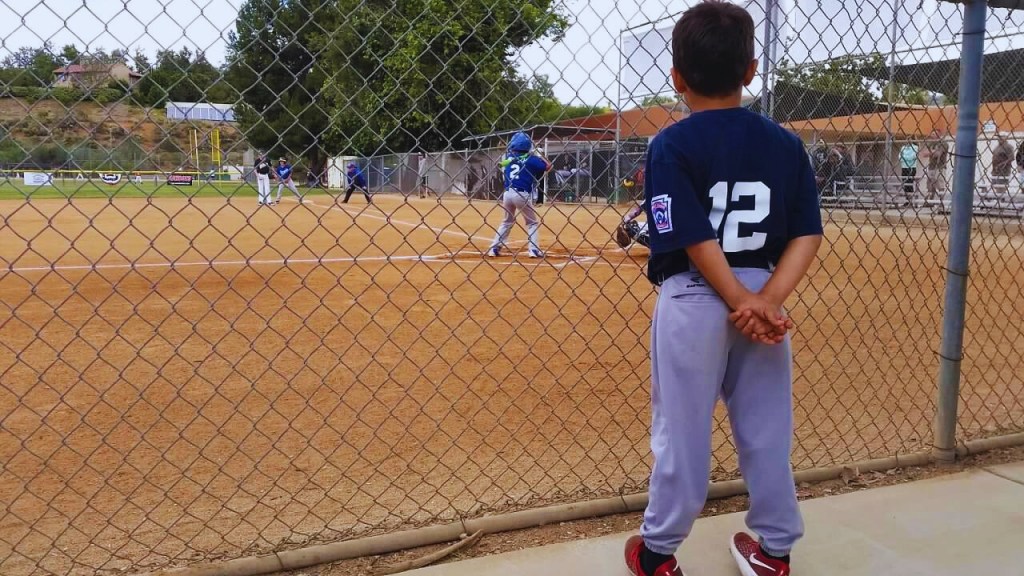
Baseball season is upon us! It’s an exciting time for players, parents and coaches – kind of like the beginning of a new school year. From pee-wee to pro, there is not one team that isn’t gearing up for the season. Youth and high school baseball are holding tryouts, college seasons are kicking off and the pros are prepping for spring training. For those newer to the sport, February might seem early – especially if there’s still snow on the ground in your town. But for those seasoned players and parents, that first pitch can’t come soon enough. Whatever phase you are in of your baseball parenting life, I can tell you that the excitement, butterflies and dreams that come with starting a new season never changes. BUT – if there’s one thing constant I’ve learned over this entire journey – baseball is HARD.
But, let’s not forget – it’s also supposed to be FUN.
Yea, I know. It’s a competition. There’s a winner and a loser in every game. And, while everyone loves to win – it’s way more fun than losing – some manage to take competition to an unhealthy level – even in youth sports. I’ve seen my fair share of disturbing behavior from parents, coaches and players. And, maybe not in all cases, but a lot of the time, the worst offenders are parents who never made it past (or even through) high school athletics. I’m not judging – I’m just sharing my observations.
Let me start by saying, I am NO angel. I’ve squawked at umpires. I’ve chirped at the opposing team’s parents. I’ve groaned at errors. So, this is as much a reminder to me this season than to anyone else. But, I will say that most of my shortcomings were with parents, even those from my own, asking them to “give it a rest” after hearing them ride an umpire or yell at their kids over and over.
I like to think that I’m defending the honor of the game. ;)
In all my years of sidelining, there is one moment I’d take back – the time when I was at my son’s 7th-grade basketball game and was yelling at the refs to start calling fouls “because someone was going to get hurt!” (See, I was just trying to protect the kids!) The fed-up ref finally looked at me and gave me a warning to which I replied, “You don’t have to kick me out – I’m leaving.” And dramatically marched out, tripped over a folding chair, broke into the shuffle step to make it look like I hadn’t tripped and then realized I had forgotten my purse so had to do a walk of shame back to the bleachers to get said purse.
I will say, though, that I have never yelled at my kids or any players for striking out, making an error, getting tagged or walking a batter. Never. Why? Because, as my husband taught me, baseball is hard. And, as a former athlete who has been on the receiving end, I know “helpful” yelling simply doesn’t work or motivate a kid.
My passion for youth sports started long before I had kids. I grew up in a family that loved sports – my grandfather was an IL Basketball Hall of Fame radio sports announcer, my dad always helped coach my brothers’ teams, pretty sure my mom bled black and gold as a longtime Purdue fan, and as the only girl (and the youngest by 6 and 8 years) who desperately just wanted to hang with my brothers, I was a tomboy. Overall, I was fortunate to have pretty incredible experiences as a young athlete which led to a D1 experience. My high school cross-country team was a bit of a Cindrella story in that our scrappy team ended up winning back-to-back state championships in Indiana in the ‘90s against programs with record-setting wins, more money and access to more resources than we could have ever dreamed. We were a team of raw talent with big hearts and a competitive spirit backed by a coach’s vision, supportive parents and a community that rallied. We faced pressure as young athletes rising up through the state rankings our first year and then ultimately defending our title a few years later. Our team competed with each other in the most healthy way to ultimately get better. And, when our coach could sense the pressure was building, he would remind us to just run and have fun. Of course it wasn’t all sunshine and rainbows but, what I can say is, I’ve tried to use all my experiences –good and bad – to foster a positive athletic environment for my kids.
Cross-Country and track are different than most sports in that one a race starts, there’s no stopping it until the last runner crosses the finish line. There’s no subbing, time outs, mound visits, pitching changes. For cross-country, the courses make it nearly impossible to see the entire race from one location. I would place a wager that most of the parents were not runners (at least when I was running) and likely have no clue what to even yell! I can tell you that most of the cheers go something like:
- “Go [Enter Athlete Name Here]!”
- “You can do it!”
- “Start kicking now!”
- “The finish is just around the corner!”
I can still hear my mom SCREAMING, “Let’s go, Coco!!”
Rarely, if at all, do you hear:
- “Why are you so slow?”
- “That person in front of you is beating you!”
- “Can’t you just run faster?”
- “Are you seriously getting last?”
And, if a runner falls? You may hear a gasp in the stands or sidelines but mostly out of shock or concern. Rarely are people actually angry. Nobody is throwing their hands in the air. Fans aren’t staring at the fallen runner, shaking their head in disappointment and mouthing, “What were you thinking?!”
I know there are parents that can ruin any situation and running is no different. But, when you lay it out this way, it really is comical, right? Like, if you were at a race and you heard a person yell, “Why are you not running faster?” you would probably give the person a SMH look. At a baseball game, when the equivalent is screamed, rarely does one bat an eye (put intended).
Maybe that’s why I literally cringe when I hear parents – doesn’t matter if it’s a t-ball game or an elite travel ball game, if they’re on our team or not – yelling “Swing the bat!” or “Throw strikes!” Or, the parent who throws their hands up in the air and huffs and puffs when an error is made.
While I really don’t understand those parents, I do think most parents aren’t malicious and some parents don’t even realize their behavior isn’t helping their child.
It reminds me of when my dad, who was a very soft-spoken and not an aggressive sports dad at all, yelled at me during a race, “Run faster!”. When I didn’t win, on the car ride home he asked me if I had let my opponent beat me?” The opponent just happen to be and still is my best friend.
Huh? What? Um, no, I was not letting her beat me. She was faster than me!
My dad probably thought he was helping me with some sort of breakthrough and didn’t realize he had likely set in motion my first experiences with performance anxiety (which wasn’t really a talked about “thing” back in the ‘90s).He didn’t know that telling a runner to “run faster” is insulting. He didn’t know that from every race going forward, if I wasn’t beating my best friend or any other opponent, that I felt like I had disappointed him. He didn’t know that what was always fun for me started to become not as fun. He certainly didn’t know that some 30 years later I’d be writing about it!
If I had the opportunity to tell him this story, I know he’d be devastated, apologize and sincerely say that “he was just trying to help.”
My guess is 99.9% of parents are doing the best for their kids with the resources and knowledge available to them. Even if they get it wrong, as an optimist, I like to believe that most parents are good people with good hearts and great intentions. But, I also know that parents – present company included – sometimes just get it wrong. I truly believe most parents aren’t trying to give their child a complex about their performance.
So, what can we do differently this season? How can we stop this “cycle” of helping that’s actually hurting?
Just like athletes are often asked to set goals at the beginning of a season, I challenge you, as a parent, to do the same.
Write your own set of goals and at the top of that list add:
- Avoid harsh comments and criticism.
- Celebrate the small victories.
- Focus less on the outcome and more on your player’s effort.
- Accept that an umpire is always right even when you think they are wrong.
- Enjoy the game. Let the players play and let the coaches coach.
Learn to accept:
- Errors will be made – they are part of a game.
- Strikeouts will happen – even the pros hear, “Strike 3!”
- Keep your cool – your kid’s team will lose once in a while (and guess what – it’s good for them!).
Taking it one step further, check out “Parenting Athletic Kids” by Travis Rogers. I believe that every parent who has an athlete should read this book. I wish I had this as a resource when I started parenting athletes. I thought I knew what was needed to parent an athlete but this book opened my eyes to a foundational, scientific, proven approach to better support my sons in their craft. From goal setting to journaling to self talk to after-game conversations, this book covers it all. This book helps offer a solution that is applicable and doable for even the youngest of athletes (and their parents) to help create a more positive and successful result on and off the field or court.
As you enter this new season, keep perspective. Remember that whether it’s their first or 15th season, your player is already putting enough pressure on themselves to perform. Before you know it, the early mornings to the ball park and late nights coming home, will eventually be over. Make the best of your time. Remember baseball is hard but it is also fun!




 Glove & Grace
Leave a comment